What you bring, what we provide
The engine is ours. The fuel is yours. Auteur Intelligence™ is the organization and the engineering: the battle-tested guardrails from real large builds, the cross-platform connectors, the persistent memory, the evaluation functions, the receipts. You bring the models that make the machine go. We are model agnostic, and we are not an underlying model provider at this time: we do not resell tokens, and we never meter your generation.
The two sides of the table
| We provide | You bring |
|---|---|
| Software-engineered guardrails, battle-tested on big builds | Your model access: subscriptions, API keys, OAuth sign-ins, or pay-as-you-go |
| Cross-platform connectors: harnesses, DaVinci Resolve, ComfyUI, providers | Hardware, if you want lanes running locally |
| Persistent memory, evaluation, and receipts on everything | A DaVinci Resolve Studio license, purchased by you, if you want the Resolve lane (Studio only; the free edition is not supported) |
| Campaign governance: gates, budgets, cross-provider review | Image and video accounts for generation, if you make pictures |
| The operations manual, onboarding, and the Skool community | Your taste, your judgment, your approvals |
Three postures, three sets of minimums
Cloud studio, the lightest start. Any modern computer, Mac or Windows, and a browser. The cloud studio does not care which operating system you run: the projects, memory, gates, and every model you connect live in the hosted workspace. Text models come from wherever you already have them, or through one pay-as-you-go account like OpenRouter, which opens access to essentially every publicly available model, big and small, behind a single key. That list is overwhelming on purpose; our engineering helps you pick the right models for each seat, and the receipts tell you what each choice really cost. Image and video come from subscription accounts you hold, direct APIs, or a pay-as-you-go service like Wavespeed AI.
Hybrid, the working filmmaker's posture. Everything above, plus a Windows PC with a recent NVIDIA GPU, and your own DaVinci Resolve Studio license for the Resolve lane. Studio is the paid edition, and it is the one we support: the free version does not expose the control surface our bridge builds on.
One thing to be clear about, because it is easy to misread: this Windows with NVIDIA requirement applies only to running models on your own GPU or driving the Resolve bridge locally. It is not a requirement to use Auteur. Mac owners are fully served by the cloud studio, and by everything in the hybrid posture short of the two local lanes.
Today the supported local stack is Windows with NVIDIA hardware, because local model inference runs on NVIDIA, and the Resolve bridge was built and tested on Windows first. A Mac release is planned, and we mean it: Apple silicon, and the Mac Studio in particular, is one of the best machines anywhere for running local models, and Resolve itself runs beautifully on the Mac. It is a matter of porting and testing the bridge, not a technical wall. As working guidance: 8 GB of VRAM runs Resolve editorial comfortably, 12 to 16 GB adds headroom for effects and grades, and 24 GB-class cards can also run the latest open-source models locally, filling classifier, judge, and draft seats without a meter. The intake questionnaire asks about your hardware, and we recommend local models matched to what you actually have.
Local studio, the private one. The full stack on your own machines: local open-source models we help you download and configure, your media never leaving the building, cloud used only where you choose. Enterprise deployments take this to its conclusion on your own servers.
Text, pictures, both
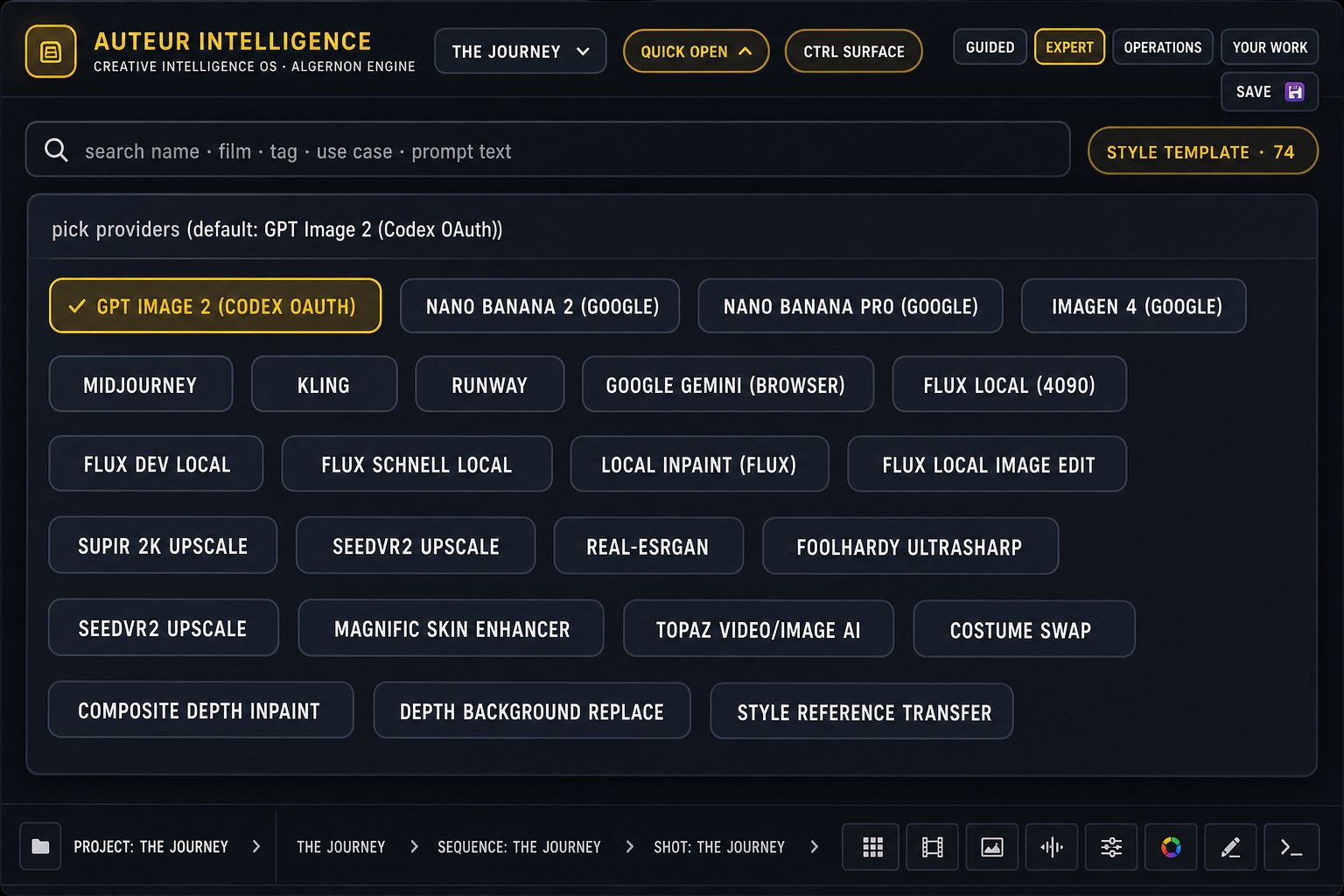
Same rule everywhere. For text generation: local open source we help you install, cloud open source, frontier models by API or subscription, your choice, seat by seat. For image and video: the accounts you already hold, direct APIs, or pay-as-you-go. The choice in how the work gets done is always yours; the organization, the memory, and the honesty about what happened are always ours.
"Here is my hardware and my accounts. Set up my seats: local models where my GPU can carry them, OpenRouter for the rest, and show me what each seat will cost before anything runs."
One model family works. Several work better.
Not a requirement, but a recommendation we make to everyone at intake: bring more than one kind of model. A mix of frontier models from different companies, open-source models in the cloud, and local models on your own hardware, in whatever combination you can hold. One family is enough to run a campaign. Two or three is where the guardrails earn their keep.
The reason is simple. Models from one company share the same training, the same habits, and the same blind spots, so when one of them makes a mistake its siblings tend to miss it in review. A checker from a different provider does not share those blind spots. The more variety you bring to the table, the smaller the chance that the same family keeps making the same mistake with nobody positioned to catch it. That cross-checking is built into every campaign; variety is what gives it teeth.
Decide at intake, not at checkout
The Founding Beta questionnaire asks what you make, what you hold, and what you run on. Access is scoped with you at admission, so you start with the posture that fits and move between them as your work grows.