Auteur Film
Auteur Film is one production pipeline from development to delivery: storyboards, previs, VFX, generation, assembly, and professional finishing, in a single project that never loses the script.
Shoot it, generate it, or both. Camera footage and generated frames share one searchable library, one set of metadata, and one DaVinci Resolve timeline. Characters hold their face and voice across the tools you use. What you approved in development is still approved at the finish.
Add Story and Prep and you have pre-production, production, and post in one place, running the same for a solo filmmaker as for a studio.
Who it's for
Directors, producers, and post teams with an approved story or script who need one connected environment to carry it through visual production and finishing.
It fits a solo filmmaker, an independent production, a VFX and post house, or a studio department, and it does not care whether the frames were shot, generated, or both.
By filmmakers, for filmmakers
This application was designed and built from the ground up by professional filmmakers, writers, and working professionals who use AI in real-world scenarios in their daily workflows, and who needed better, more reliable solutions than the market offered. Its founder has spent over 25 years in the film industry as a writer, director, and editor of award-winning feature narrative films and documentaries.
“Use ComfyUI to replace the face in this close-up hero shot with the approved younger reference. Tag the new take, preserve the original, and place the result on the correct Resolve timeline.”
One library. Any provider.
Auteur Film does not care who made the asset. Runway can mingle with Higgsfield, Midjourney with Google Veo, local ComfyUI running LTX 2.5 beside Minimax H3, all on the same canvas, with the same capabilities. Footage you already had sits next to what you generated this morning. Every asset lands in one shared media library, instantly searchable, and instantly round-trippable to your Blackmagic Design DaVinci Resolve project with organized, custom metadata you could not get from single accounts alone.
Your accounts. One shootout. Connect Google Veo, Runway ML, Higgsfield, and Wavespeed AI the way you already pay for them; Auteur is the connectivity layer, not the meter. One prompt runs as a shootout across their model families, every take lands in the library with its lineage, you pick, and the pick is staged into DaVinci Resolve with a receipt.
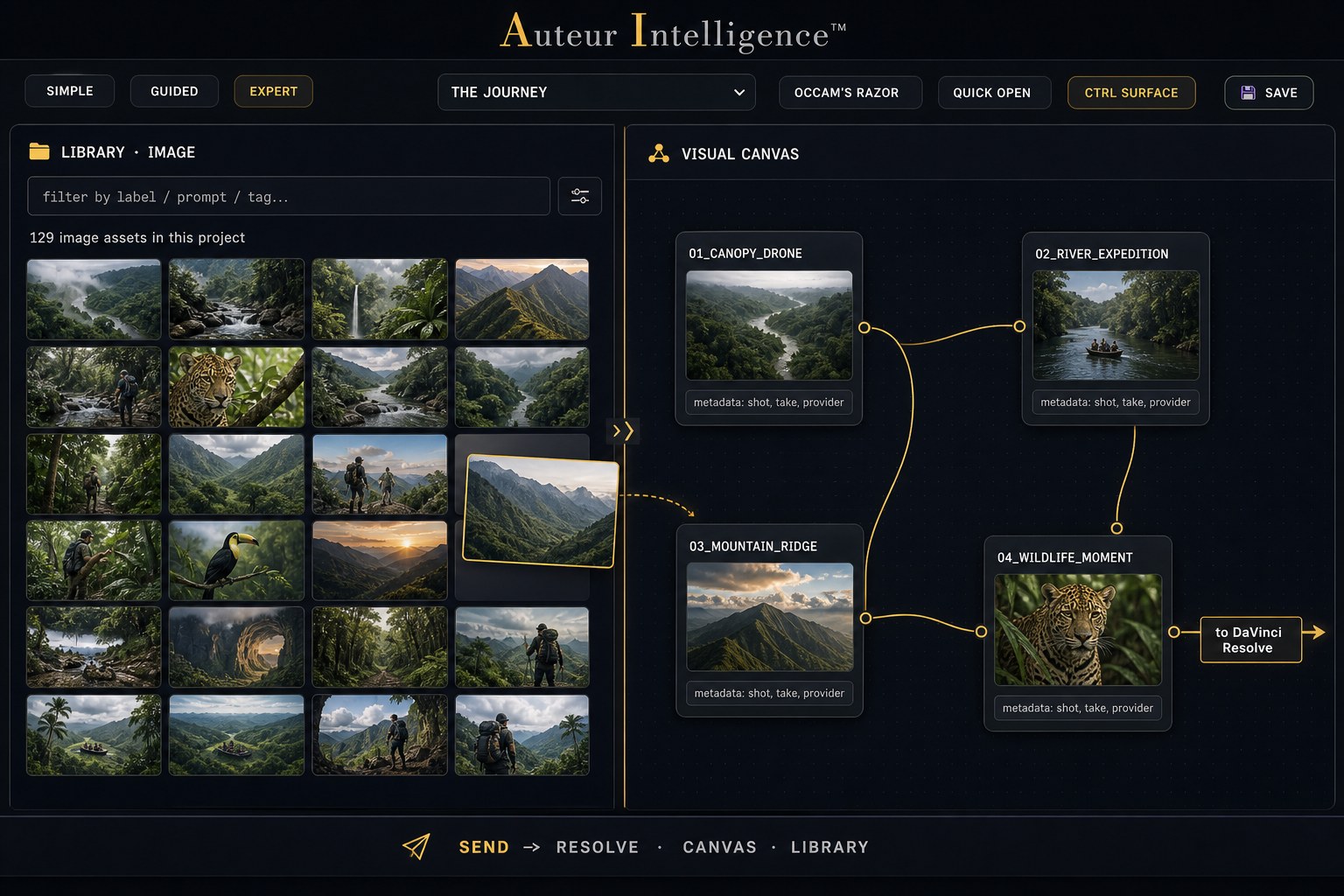
The library and the Visual Canvas work as one surface. Drag an asset from the library onto any canvas, storyboard, or comic panel in any project, and drag results back. Share assets between projects without ever closing one or the other. The metadata rides along, built from the start for Resolve round-tripping.
This exists because it hurt. The Auteur founder, cutting large documentary and narrative projects as an editor and director, kept losing assets across multiple AI generation accounts: which take worked best, which account made it, which version was approved. Unraveling that and getting the right footage onto a timeline took hours. So we made the studio stop caring. A local classifier with vision looks at every asset as it arrives, pre-existing or freshly generated, whoever made it, and writes the base metadata every lane shares. The same search finds it from any of your harnesses, from a single term typed into the Auteur dashboard, or from inside DaVinci Resolve.
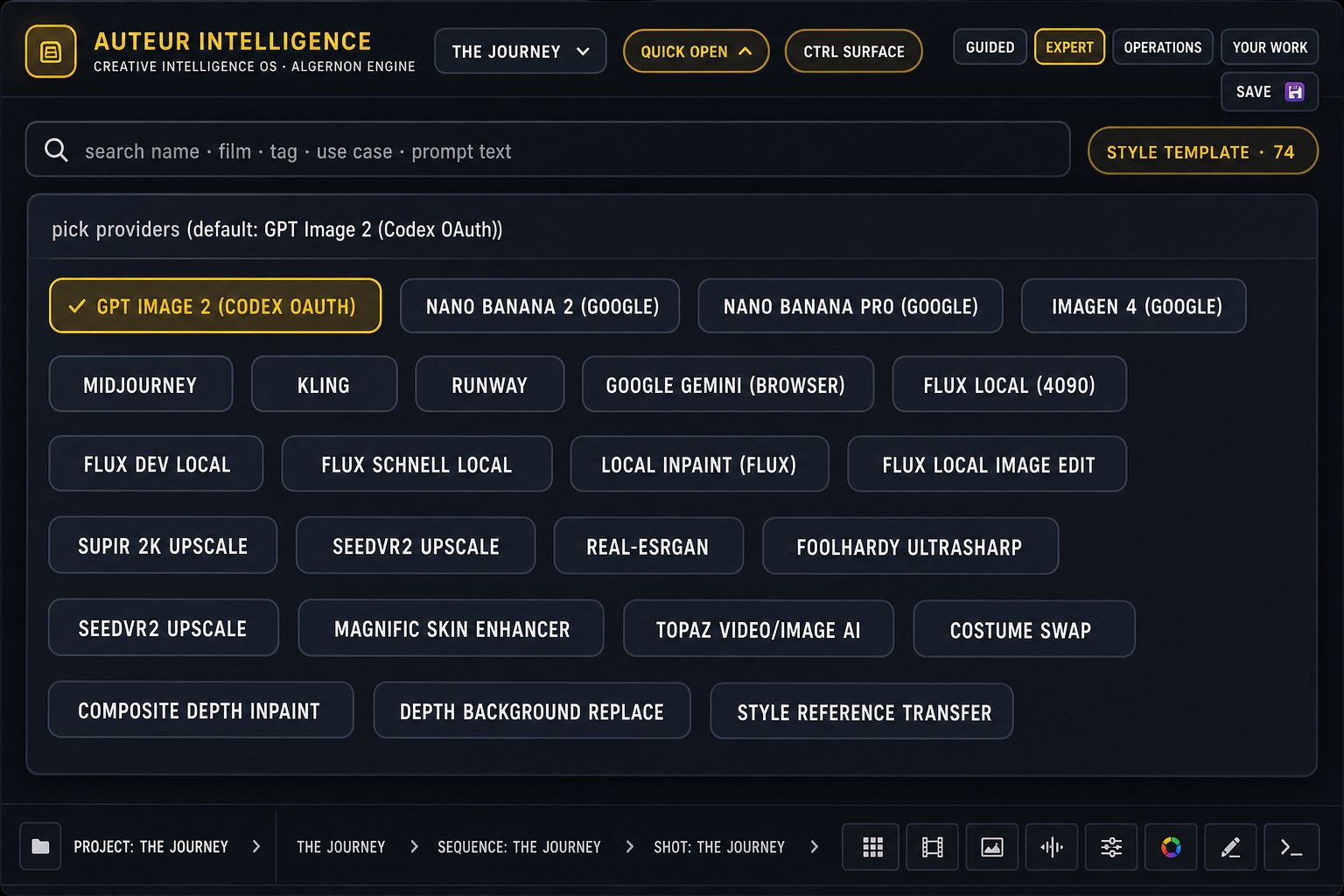
"Pull every river shot I approved across the last three projects, whoever generated them, and stage the best six as a storyboard for the opening."
Character voice and identity
Ask anyone who has tried to make a film with standalone image and video generators: the character drifts. The face changes between scenes, the voice changes between sessions, and by minute forty your lead is a stranger wearing your lead's costume. Long-form work dies on that drift.
Auteur Film locks it down. Every character carries a reference sheet, face, wardrobe, look tokens, and a cast voice identity, and that sheet automatically reaches any provider you are using through the visual and audio-visual canvases. Whoever renders the frame, whoever speaks the line, the same identity rides along, whichever provider is doing the rendering.
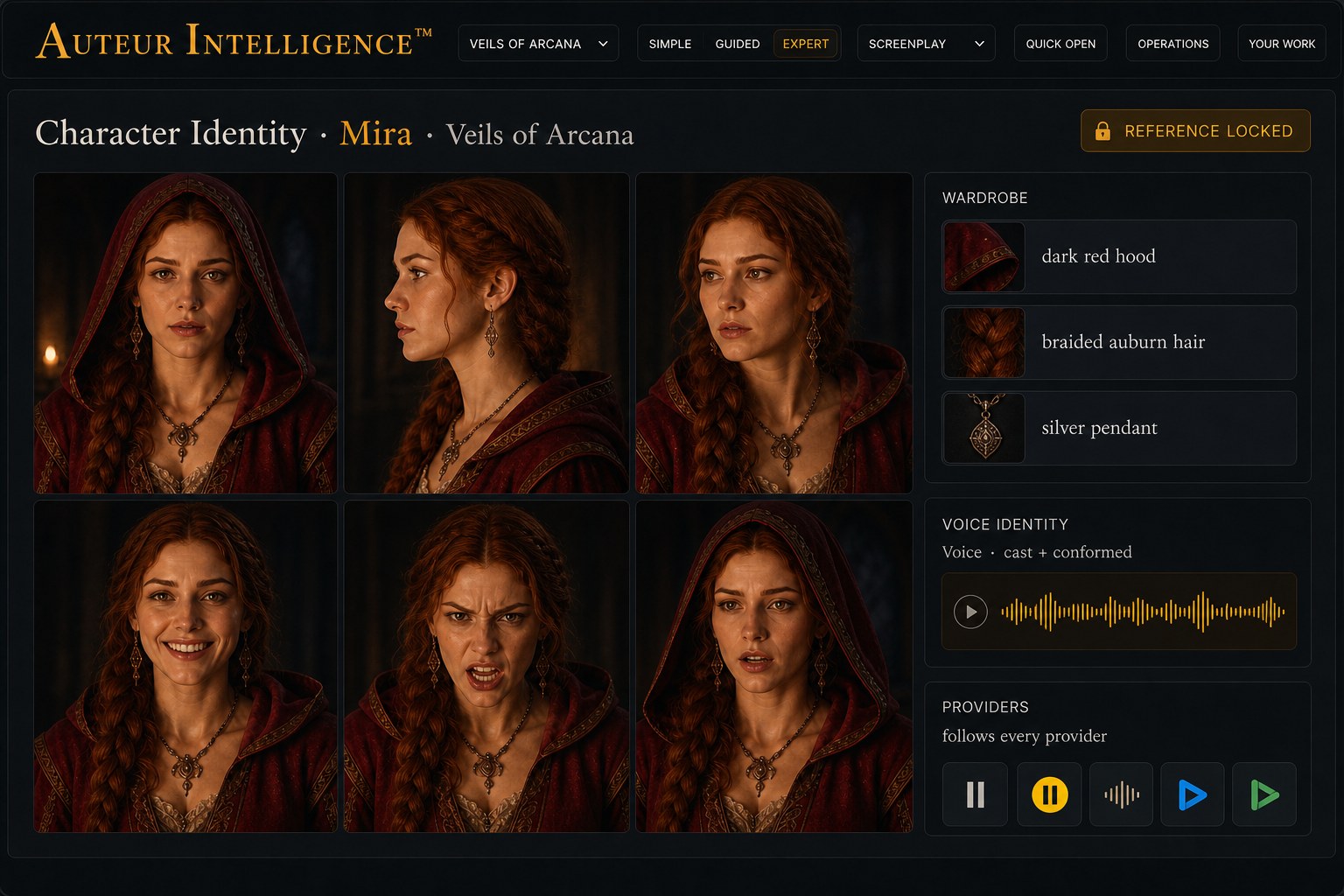
Tie it into Story Forge and the identity is not frozen; it evolves. A character can age, scar, harden, or soften on schedule and in character, because the look and the voice follow the story's own history. Short film or feature-length narrative, documentary reenactments that must keep the record straight: the film system is modular enough to hold identity across all of it and keep the story on track.
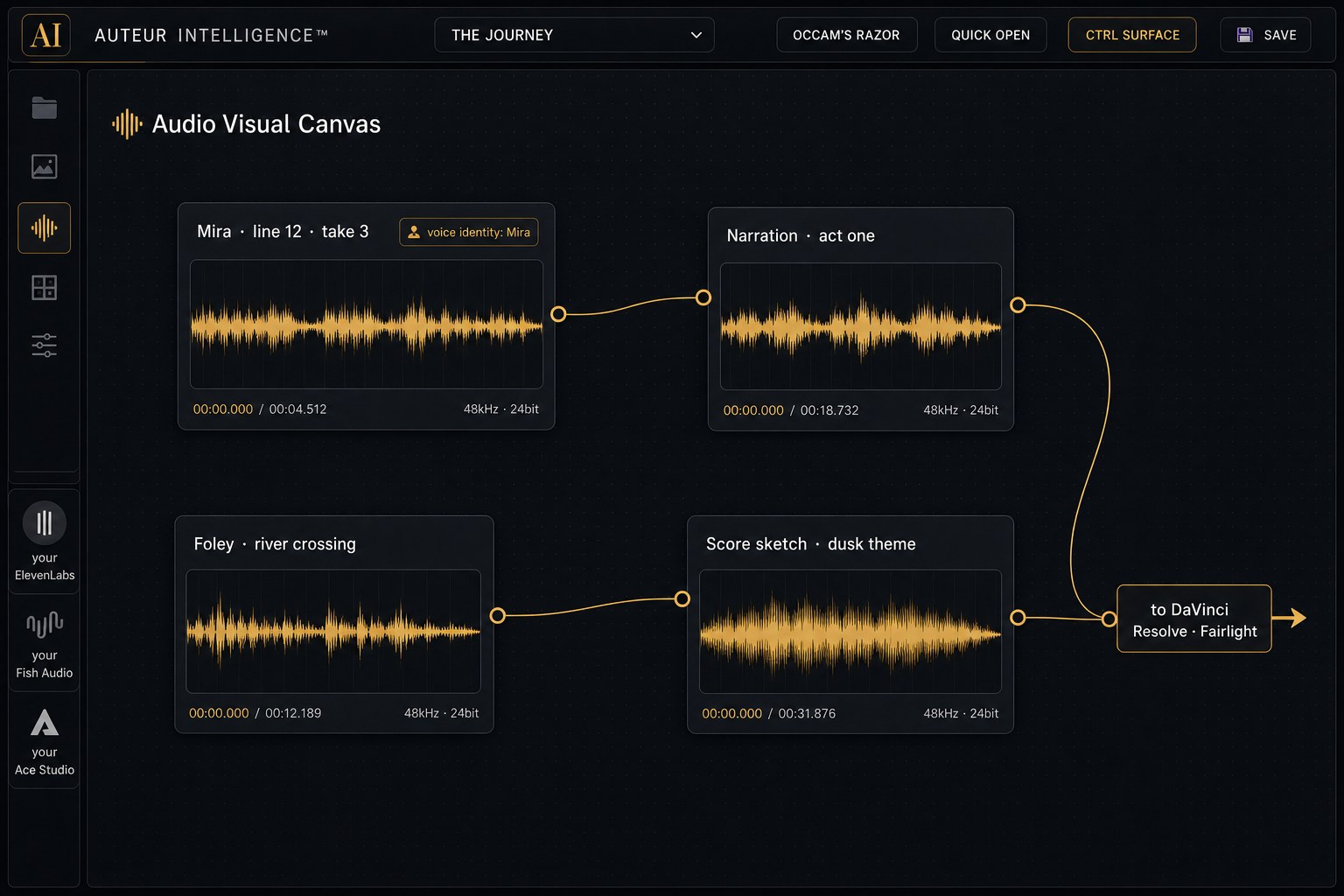
"Hold Mira's face and voice through act three, but let the siege age her: two years harder, a scar over the left brow, the voice a half-step lower. Update the sheet, and whoever renders her follows."
Previs in a real engine
Don't spend expensive generative-video money figuring out blocking and composition. Figure it out cheaply in Unreal or iClone first, approve it, then spend the generation money. That is not an AI novelty. That is production cost control.
Pair Auteur Film with Auteur Game and a real engine, and previs stops being guesswork. Blocking, sets, and camera moves live in Unreal Engine or Reallusion iClone, both of which already answer the studio's tool calls, with Unity and Blender support planned next. Game Forge works beside Film Forge to search the assets you already own, every prop, set, and item, and assemble them into the scene reproducibly, so the same shot comes back the same way every time.
The money argument is simple. Frontier video generation on platforms like Seedance 2.5 is spectacular and costly, and every mistaken roll is money gone. Engine previs lets you lock composition, continuity, coverage, and timing before you pay for a single frame of generation, so the expensive roll lands right the first time. Automated previs is not a toy in this studio; it is how the generation budget survives a long project.
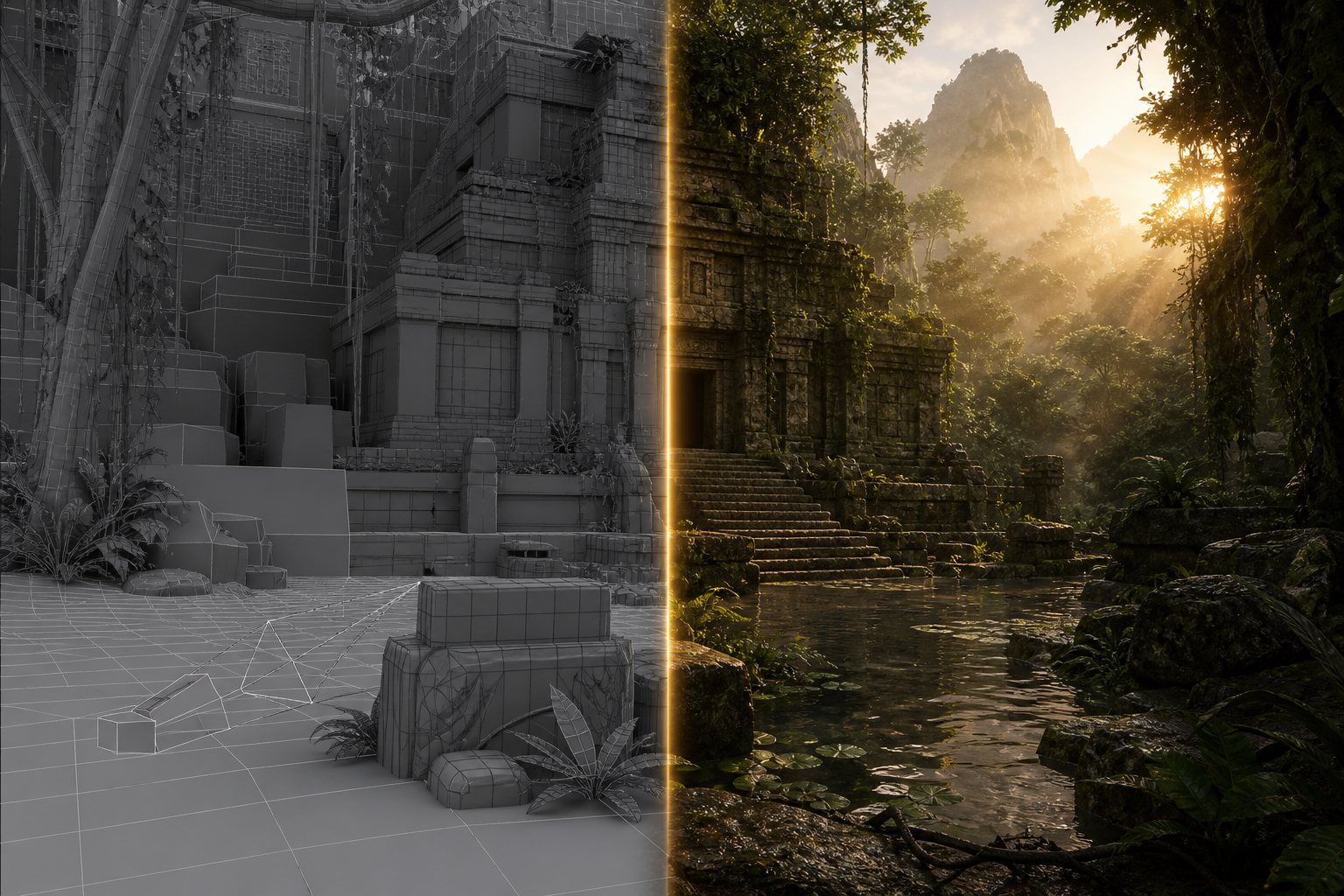
"Pull every castle prop and set we own into a previs of the courtyard duel, block the crane move in Unreal, and only send the locked frames to the video model when I approve them."
Prompt Studio: the recipe shelf
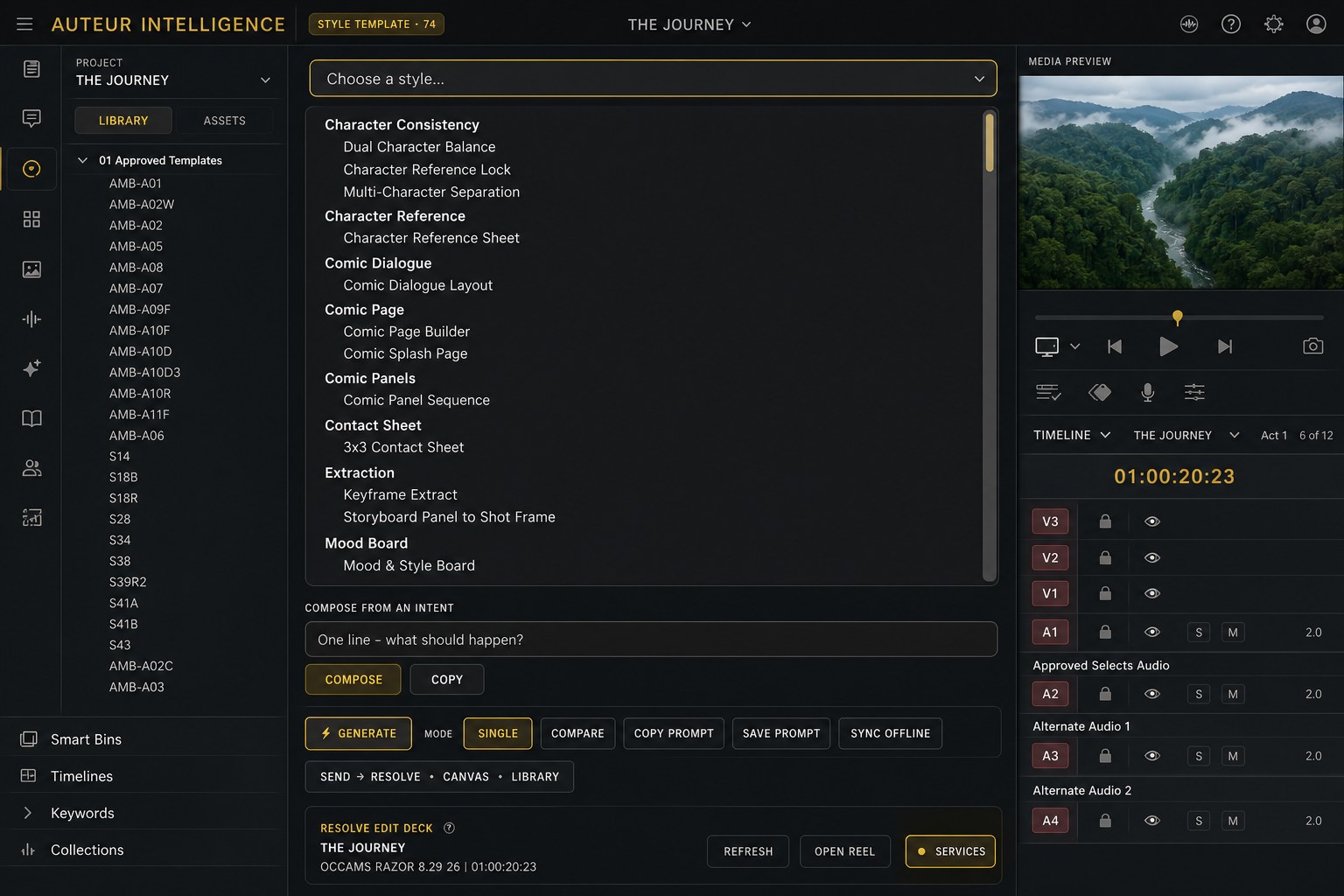
Prompt Studio ships with 74 in-house style templates on the shelf today: character consistency locks, comic page builders, contact sheets, keyframe extraction, storyboard-to-shot conversion, mood boards, and more, each one a production recipe that took real hours to learn. Audio, video, and musical composition recipes join the shelf when you hook in a provider you already hold: ElevenLabs or Fish Audio for voice and sound, Ace Studio for musical composition. Describe an intent in one line and the studio composes the full production prompt for the provider you picked.
Auteur Resolve, inside Resolve
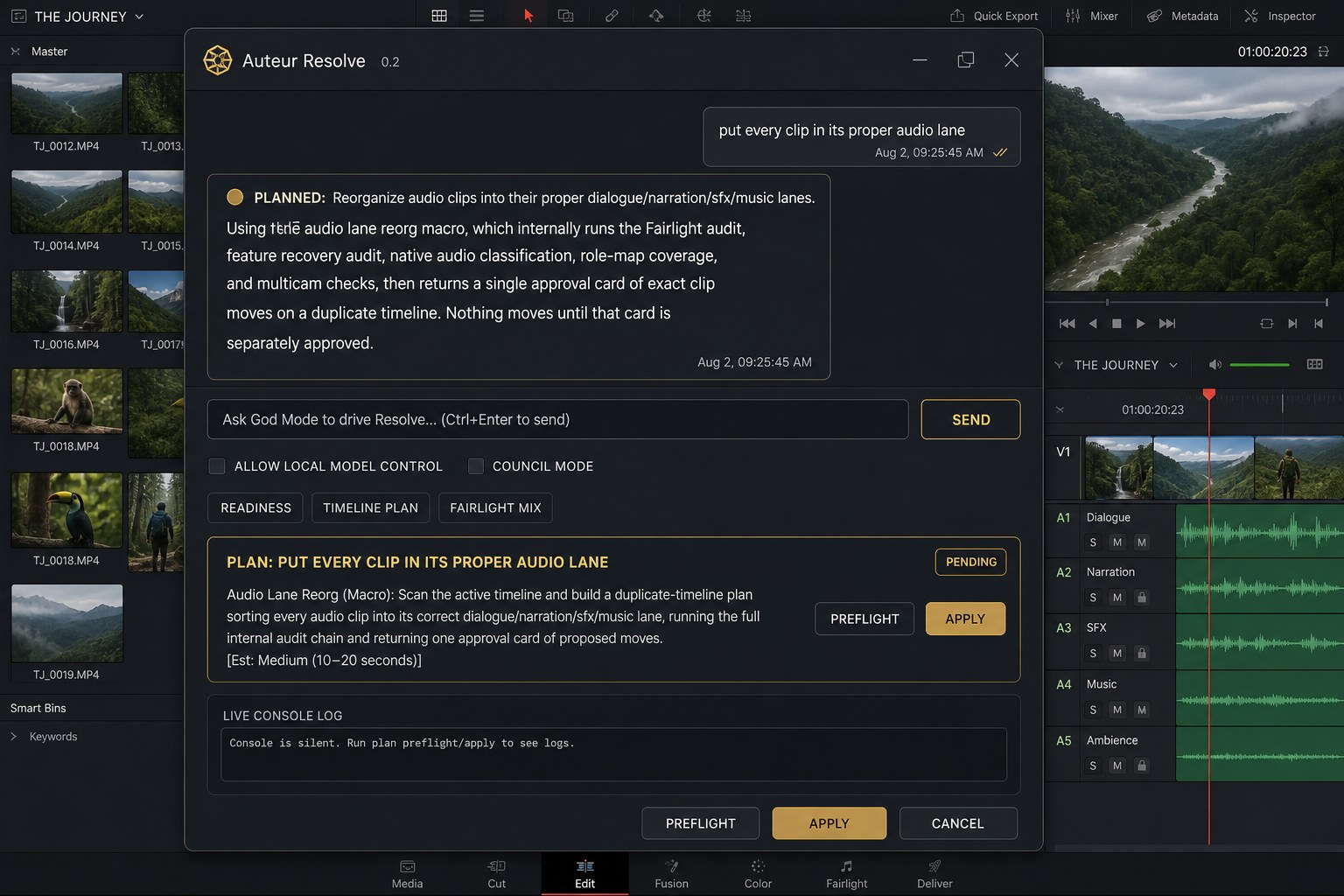
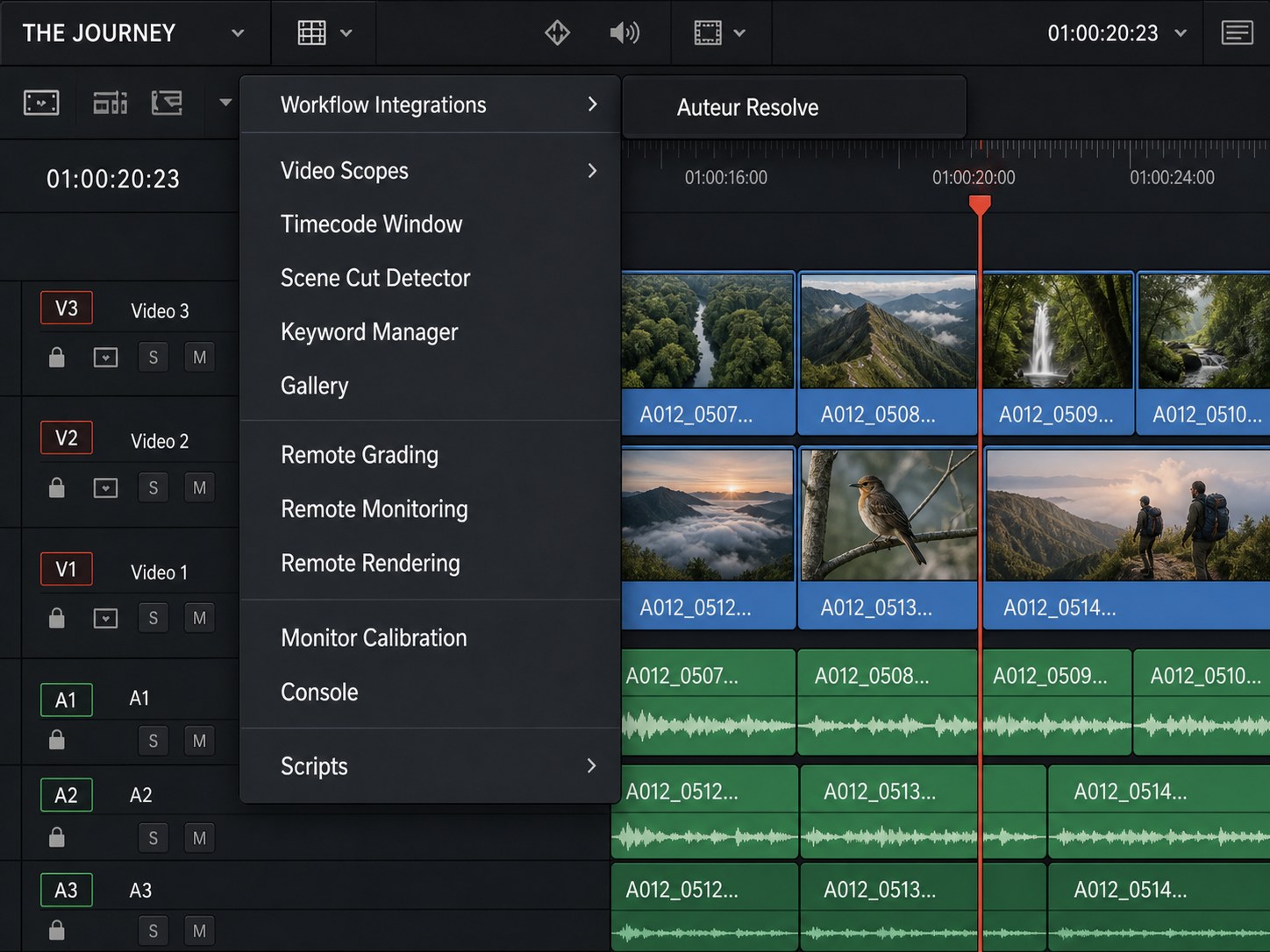
If you would rather live inside the editor, the same functionality ships as a workspace integration plugin that runs inside DaVinci Resolve itself: Workspace, Workflow Integrations, Auteur Resolve. The panel speaks the same natural language, plans before it touches anything, and nothing moves until you approve the plan card. The shared metadata layer means the library search that works in your harness works here too. And your AI-created content comes with you: what you make in the Auteur dashboard ports straight into Resolve, and unlike other platforms, ours is totally provider agnostic. Whatever your chosen image, video, or audio generator, ElevenLabs, Wavespeed pay-as-you-go, Higgsfield, Runway, Kling, or Google, you add the API, CLI, or subscription as those providers allow, and it ports into Resolve with its metadata intact.
From breakdown to batch references
The visual pipeline starts at the script: breakdown identifies every scene's world and characters, and the studio batch-generates reference imagery for each, worlds, characters, looks, scene by scene. Generation then runs through the third-party providers you choose: pay-as-you-go APIs, or your own subscriptions where their terms allow, with every output registered to the project.
What it solves
Most tools give each stage its own idea of what a shot is, and the project fractures. Film keeps one production identity for sources, scenes, shots, immutable render versions, and their downstream bindings, so an approval made in storyboard is still an approval at assembly and again in Resolve.
“Generate the ferry scene in three visual directions, keep identity locked to the approved character sheets, and stage the winners against my shot list.”
How it works
You work one production forward from source material to a finished cut, choosing local or connected provider execution, running against your own accounts, while the creative project, references, and approvals stay the same throughout.
Workspaces included
- Cinema Forge, scene, dialogue, and performance development.
- Visual Pipeline, scene-to-shot progression with reference attachments and approval gates.
- Visual Canvas, provider-neutral image and video generation with shootouts, variants, lineage, and receipts.
- AV Canvas, a project-aware timeline for picture and multi-track audio.
- Character Voice & Audio, durable character voice identity carried across writing, film, and game.
Embedded from other products
Auteur Prep is included in Film, its coverage, breakdown, and production graph, not a separate line item and not a second signup.
Moving up
Generated and traditional media can move into Auteur Edit for governed DaVinci Resolve finishing, engine previs comes from Game, and Studio bundles the shelf.
Where it runs
Generation runs locally or against your own connected provider accounts, with the creative project and its authority beside the work.
Demonstrated
By 2026-08-28, the end-to-end path from source through assembly to a Resolve handoff had run with committed local canary evidence rather than a staged demo.
Current limitations
Film is a connected production environment, not an automatic movie maker: each stage is generated, reviewed, and approved by you, and the guided route produces a draft to finish, not a delivered feature.
Related products
Story · Game · Edit · Learning · Conductor · Studio
Questions
Can I bring an approved story straight into Film? Yes. Film picks up an approved story or script and its Prep breakdown without rebuilding them, and carries one production identity through to the finish.
Take the next step
Apply for the Founding Beta, /founding-beta/. An application to work alongside us; this starts a conversation with us, and seats, when offered, are paid.
Proof
Every claim on this page traces to the product status registry, with evidence in contracts, adapters, and a committed canary receipt, last verified 2026-08-28. The receipts behind it are claims FILM-001–008, FILM-013.