Auteur Story
Develop and finish long-form stories in a project that keeps its own canon, structure, and editorial history instead of losing them to the chat window.
A writing room with a long memory: the manuscript, the corkboard, and the notes in the margin all stay in one place, and they are still there next week.
Who it's for
Novelists, screenwriters, and documentary makers who are carrying a real long-form project, not a single prompt, but a book, a script, or a season that has to stay coherent across months of revision.
By storytellers, for storytellers
This application was designed and built from the ground up by professional filmmakers, writers, and working professionals who use AI in real-world scenarios in their daily workflows, and who needed better, more reliable solutions than the market offered. Its founder has spent over 25 years in the film industry as a writer, director, and editor of award-winning feature narrative films and documentaries. A platform by professional storytellers, for storytellers at any level of expertise.
“I have an idea. Capture it in Intake, identify its strongest genre and dramatic arc, then open the Mentor Rail so I can explore how a great director would approach it, and let me spitball with the mentor.”
Your models, your rules
The writing pipeline runs the same two-tier economics as the build system: local models draft, frontier models refine, and eval judges what survives, deep work at a fraction of the token cost. And because models attach as seats, the choice of seat is yours: for mature or unrestricted genres, attach the less-restricted local open-source or cloud models that fit the work, on your hardware or your accounts, under your control.
Every kind of writing
Story is built for the long forms and the demanding ones: novels and series, screenplays and teleplays, documentaries, short fiction, and serious non-fiction, and the same project carries marketing and campaign copy when the work goes out the door. Whatever the form, canon, structure, and editorial history stay with the project.
The lens shelf
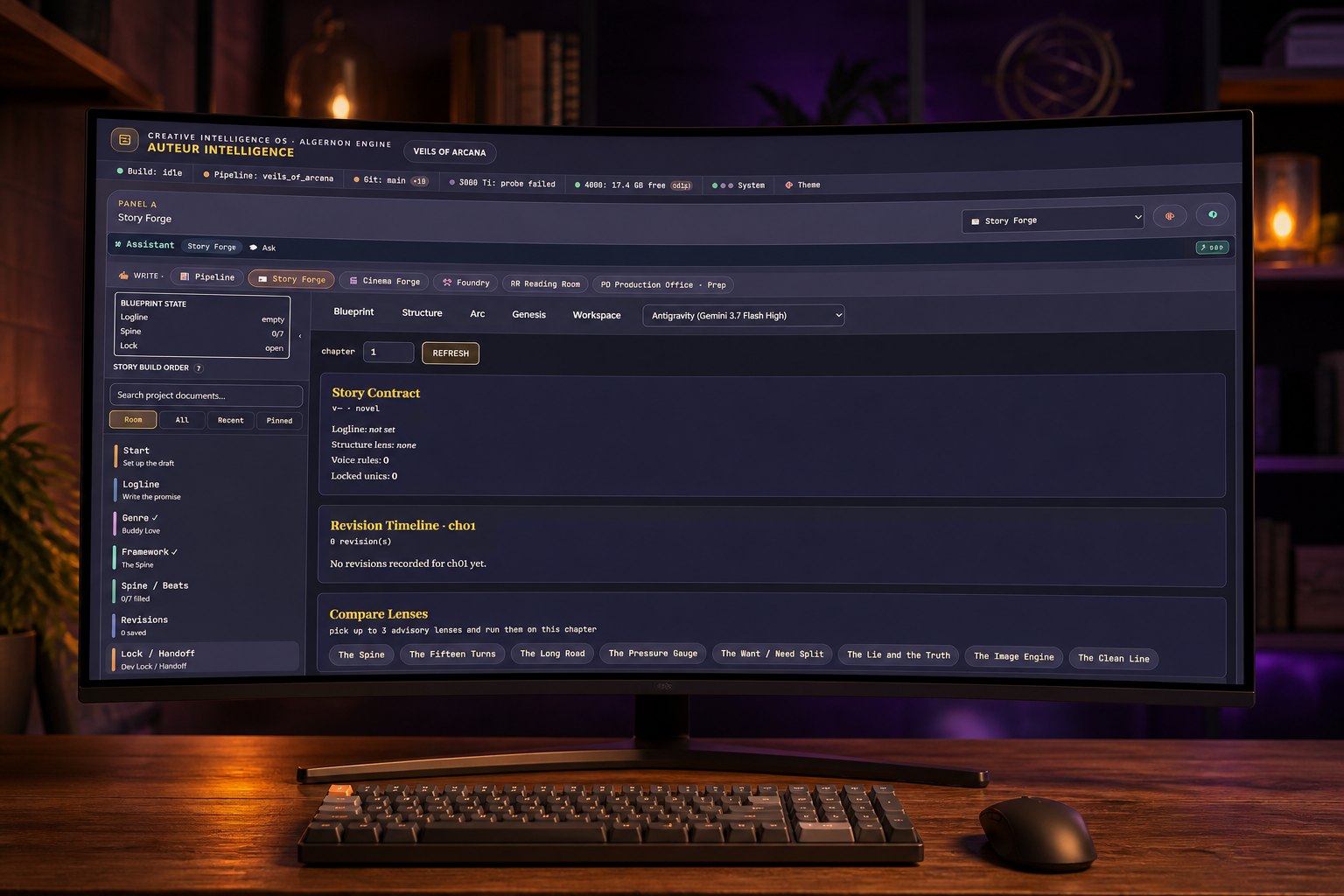
Genre Lenses are not vibes; they are twenty-five named structural instruments, each with a job it tests the draft against. A sample from the real shelf:
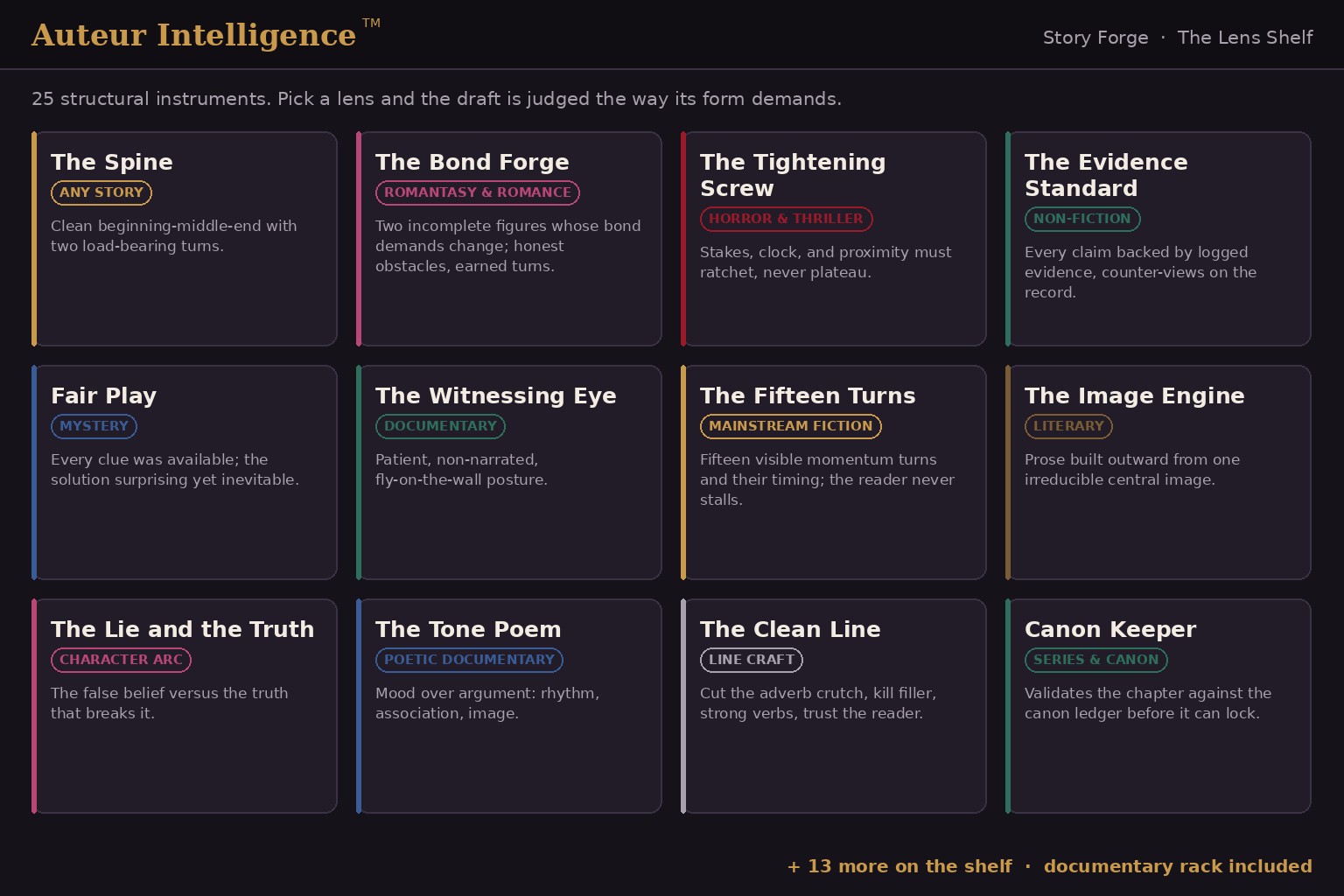
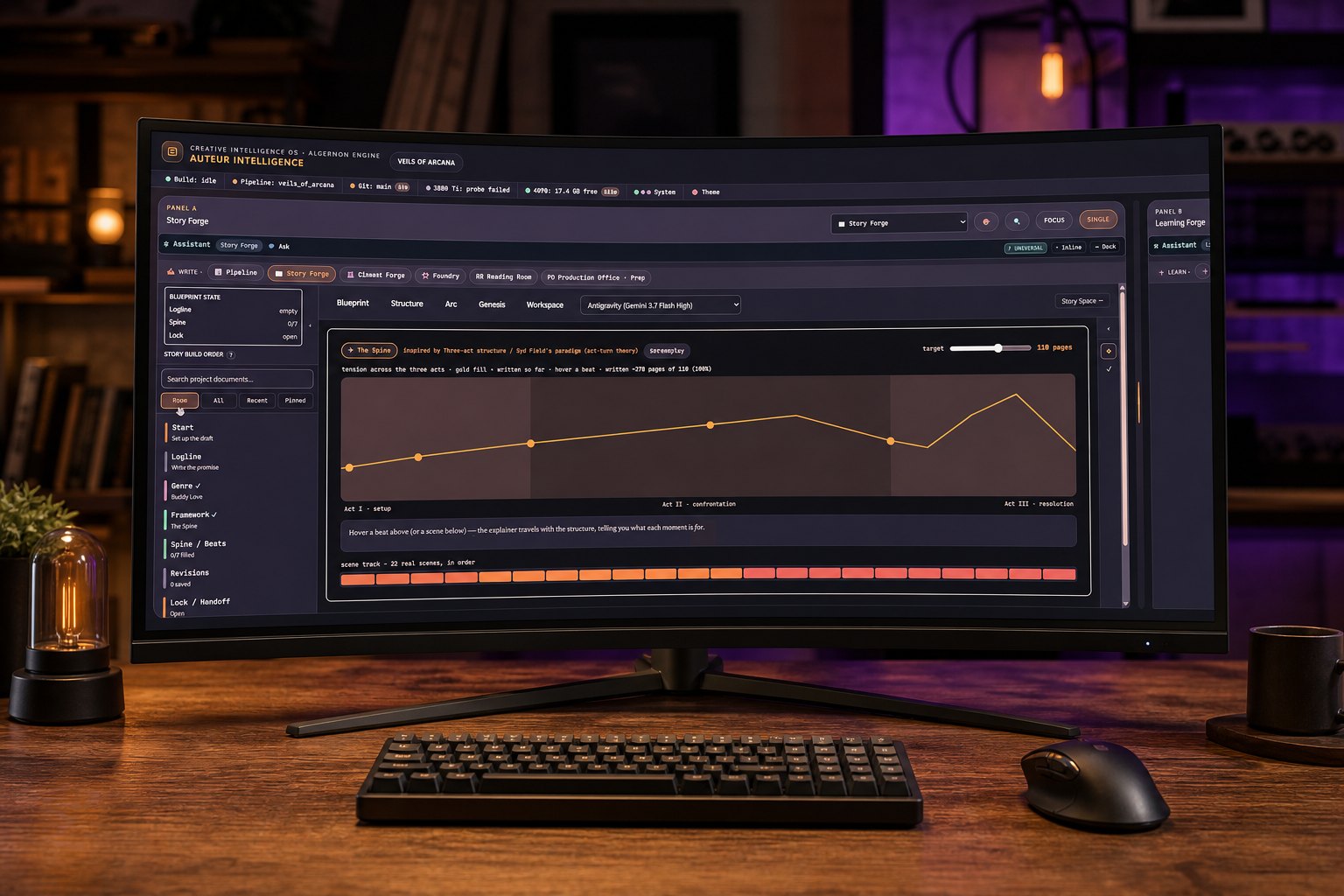
- The Spine. Clean beginning, middle, end, with two load-bearing turns.
- The Fifteen Turns. Fifteen visible momentum turns and their timing, so a mainstream reader never stalls.
- The Long Road. The transformation arc, without forcing every beat.
- The Pressure Gauge. Per scene: did a charged value actually flip, or is it filler?
- The Lie and the Truth. The false belief versus the truth that breaks it.
- The Image Engine. Prose built outward from an irreducible central image.
- The Clean Line. Line-level rigor: strong verbs, no filler, trust the reader.
- Fair Play. For mysteries: every clue available, the solution surprising yet inevitable.
- The Evidence Standard. For nonfiction: every claim backed by logged evidence.
- Canon Keeper, The Fidelity Check, The Continuity Gate. The gatekeepers: a chapter validates against canon before it can lock.
Documentary forms get their own rack, from The Witnessing Eye to The Tone Poem. Pick a lens and the draft is judged the way its form demands.
“Run The Pressure Gauge over act two and mark every scene where nothing truly flips. Then flip chapters nine through twelve into screenplay format and flag whatever loses interiority in the move.”
Write with your character in the room
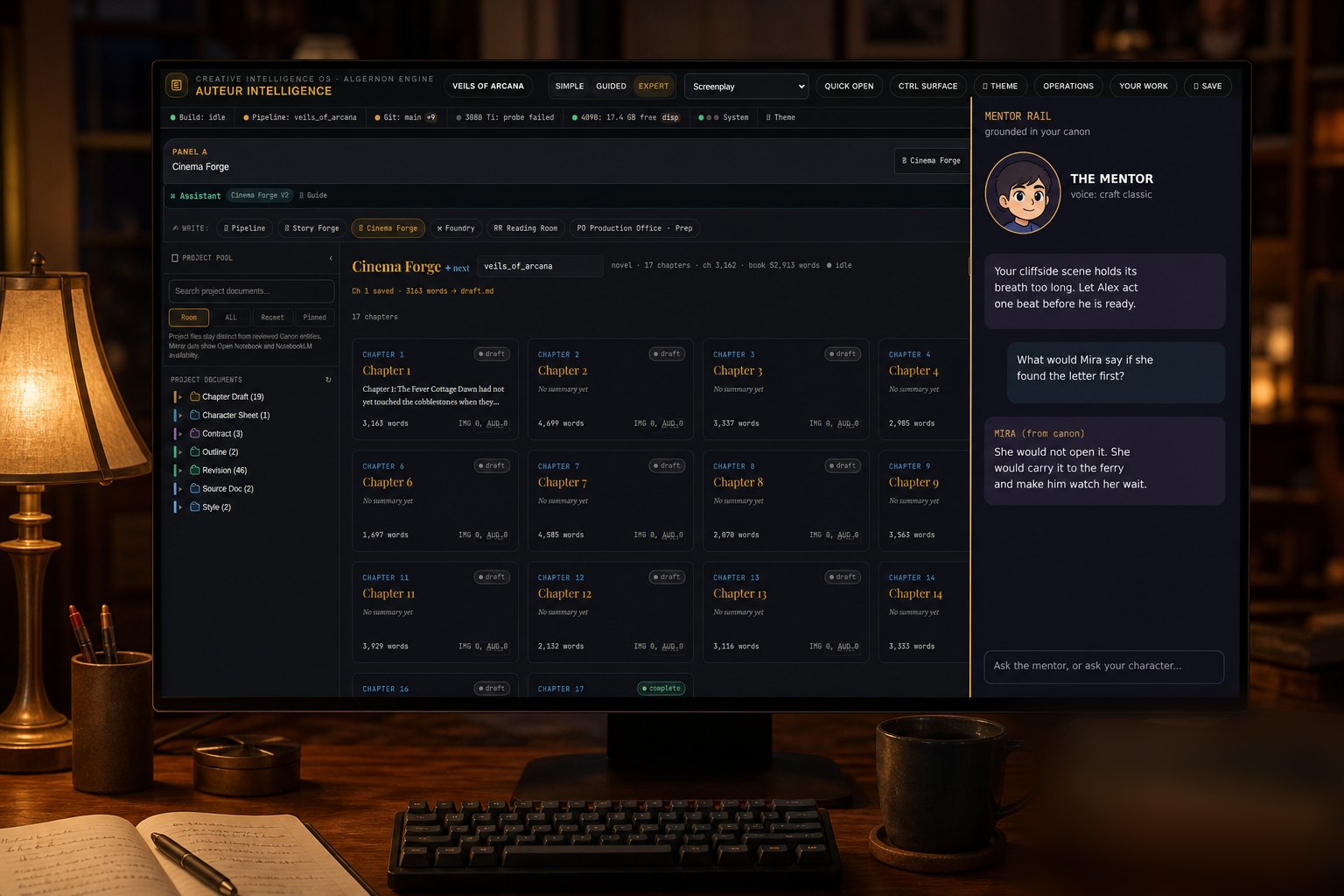
This is the part nobody else ships: as you write, your character can sit beside the manuscript, with a face. Give your character or your mentor a visual presence in the rail next to the page, ask them questions, and get answers grounded in the project's actual memory: what they have done, what they want, what they would never say. Character-building advice from the character, mentor guidance in the mentor's own voice, while you draft. The manuscript stays yours; the room just got better company.
“I am stuck on the ferry scene. Mira, why won’t you just tell Alex about the letter before he boards?”
You, to your own character, mid-draft
“Because the moment I tell him, he stays. And I have spent eleven chapters teaching him to leave. Let him read it on the water, where turning back is not an option, and my silence becomes mercy instead of betrayal.”
Mira, answering from canon, memory, and eleven chapters of your draft
Live voices for the people you invented
The character room goes further if you want it to. Connect a voice provider you already hold, ElevenLabs, GPT voice, or another of your choice, and your mentor or your characters answer out loud in real time. Add a LemonSlice account and the avatar animates live while you talk. The result is a brainstorm session with the very characters you are writing, grounded in your canon, which is the fastest way over writer's block we know. Voice and animation accounts are yours, connected on your terms. What we provide is the long-term intelligence and history behind the voice, and that is what makes it useful.
Every draft you ever wrote, still yours
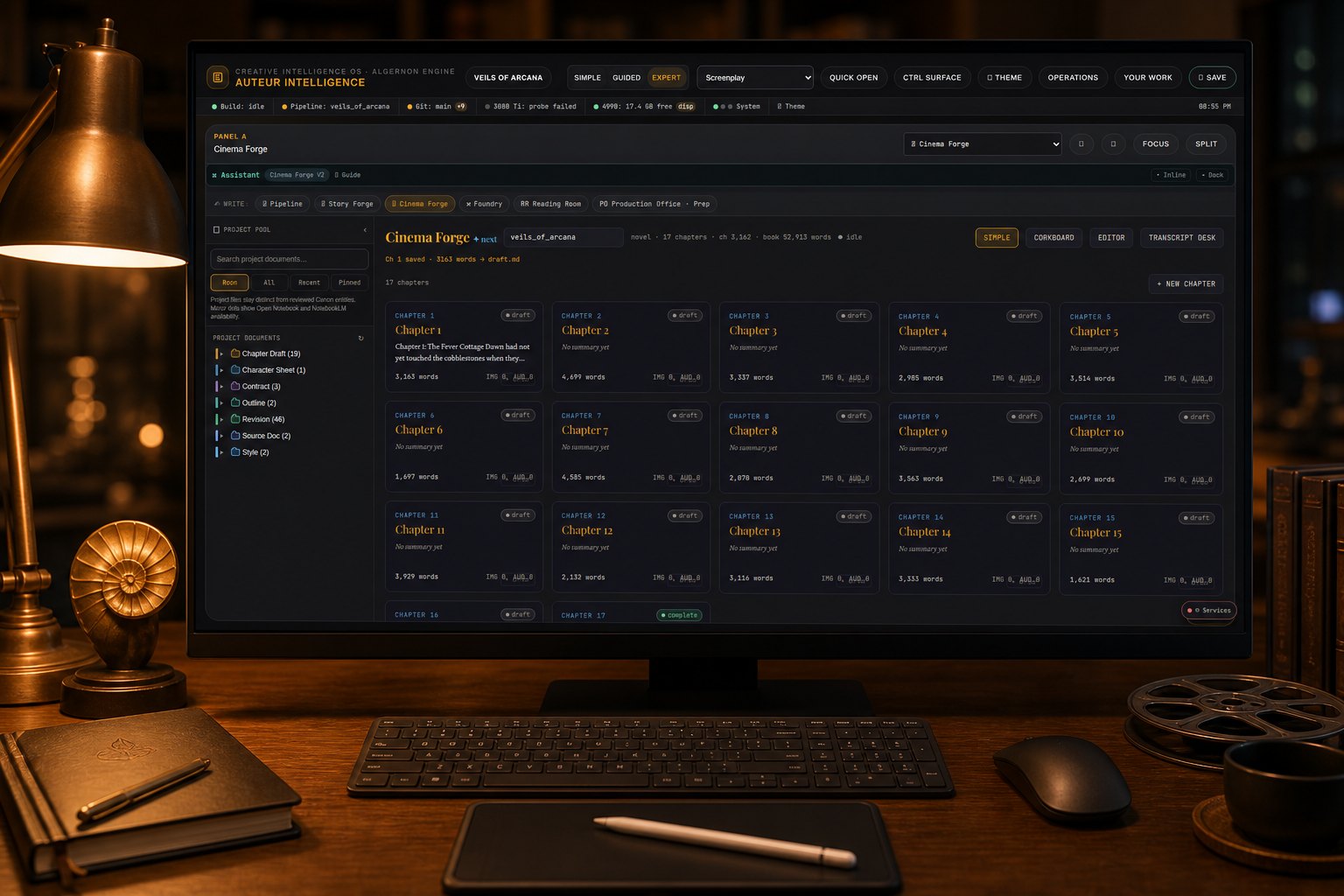
Cinema Forge holds your revisions the way software teams hold code: a real version-controlled history of everything you write. Keep every draft, revert any revision, and go back to the version from last Tuesday without ceremony. Compare drafts side by side and make selections between them. Highlight a passage and change it on the fly, with the mentor at your shoulder, or with a character rewriting it in their own voice, gleaned from all the work you have already done and the canon and world building you have committed to memory. Nothing you write is ever lost to the rewrite that replaced it.
“Show me chapter seven as it stood three drafts ago, side by side with today’s. Keep today’s opening, restore the old ending, and have Mira rewrite the bridge between them in her voice.”
Speak, and the studio answers
The writing room is wired for voice. OpenAI voice, ElevenLabs voice agents, and Fish Audio connect into the same natural-language harness that runs the rest of the studio, on top of a catalog of more than five hundred scaffolded operations, and you can write your own recipes and call them by name, in plain language, like everything else.
What it solves
Chat sessions forget the world you built two chapters ago. Story keeps canon, scene structure, and editorial history as durable project facts, so a decision made early is still binding late, and a rewrite can be reviewed instead of silently overwriting the draft.
How it works
Your writing stays grounded in the project rather than a throwaway conversation: canon, continuity, and craft checks cite the source text, and voice editing and cross-checks stay attached to the work. Automated notes arrive as proposals, and approved canon stays under your control.
Workspaces included
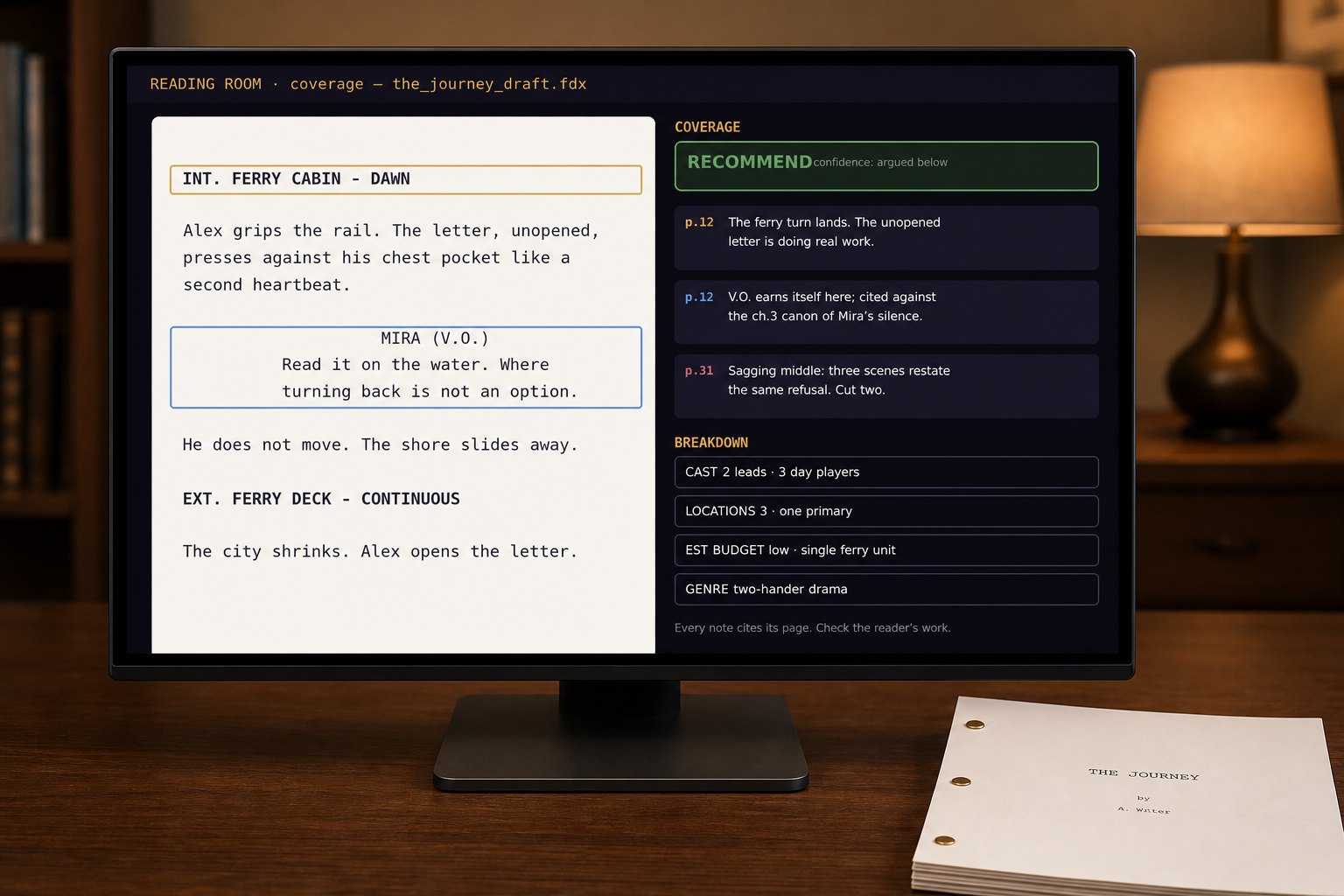
“Import my existing draft, give me full evidence-linked coverage by morning, and cite every margin note to the page so I can check your work.”
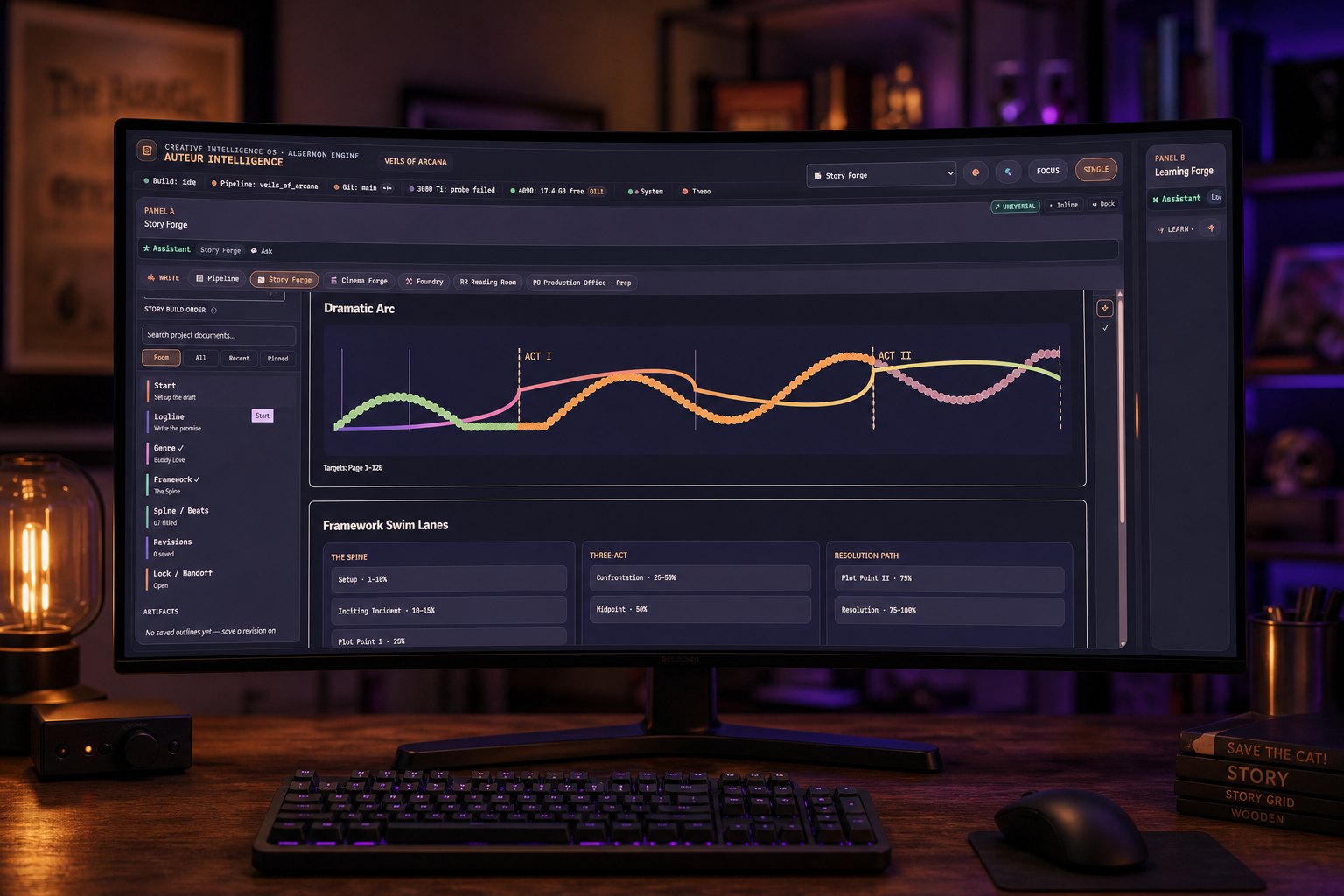
- Story Forge, chapter and scene development for novels, screenplays, and documentary work.
- Reading Room, evidence-linked manuscript review and script coverage that reads an existing draft without overwriting it.
- Editorial Lenses & Craft Packs, explicit craft lenses you can apply one at a time or together, showing where they agree, disagree, and cite the page.
- Character Voice, durable character voice identity that later carries into film, game, and learning work.
Embedded from other products
Story does not fold another paid product inside it. What it produces, approved canon, scene identities, characters, and research, is what carries forward into Prep, Film, and Game, so the story you build once keeps its identity downstream.
Moving up
When a story is ready to become a production, the same project moves into Prep, Film, and Game without rebuilding it. Studio bundles the whole shelf.
On the deck
The Writing Room travels: draft and direct the manuscript from Control Deck, with canon and the rails beside the page.
Where it runs
Depending on your system and the products you select, Story runs locally or in the cloud: the engine and your manuscript can live on your own machine, in your hosted studio account, or in the hybrid mix between them, with the authority layer beside the work either way. The postures are laid out on the requirements page.
Demonstrated
By 2026-08-28, long-form writing, screenplay, and documentary development had run end to end, and manuscript review and script coverage had run against real drafts, returning notes linked to the source rather than invented summaries.
Current limitations
Story drafts with you rather than for you: automated notes arrive as proposals, and approved canon changes only under your control, never as a silent rewrite.
Related products
Prep · Film · Game · Learning · Launch · Studio
Questions
Does it write the book for me? No, Story drafts with you, not for you. It keeps your voice and your structure as the book grows, so the work stays yours.
Can I bring in a manuscript I've already started? Yes. Reading Room imports an existing draft, preserves the source, and returns evidence-linked editorial notes without overwriting your work.
Can I get my work back out? Yes. Your work stays yours: the source is preserved, and Story is designed to hand your writing and its linked evidence back to you rather than lock them in.
Take the next step
Apply for the Founding Beta, /founding-beta/. This is an invitation to work alongside us; this starts a conversation with us, and seats, when offered, are paid.
Proof
Every claim on this page traces to the product status registry, with evidence in code, user manual, and project use, last verified 2026-08-28. The receipts behind it are claims STORY-001–007.