I thought it would replace me
From the founder · 2026-08-31
For a while, I saw AI as a competitor. I had more than one existential night wondering whether this thing was going to quietly make me obsolete, whether the work I had spent a life learning was about to be done by a machine that never went to film school.
Then I used it. Every day, in real work. And the fear turned into something more useful: clarity. AI could not replace my vision, or the years of expertise I earned the hard way, or the particular way I tell a story. What it could do, used correctly, was multiply that vision. Not a replacement. A force multiplier.
But using it was a mess. I spent too much of my day navigating too many interfaces, fixing the same bugs, and losing track of my own assets, burning time on searches just to find what I already had. The providers kept leapfrogging each other, week after week, so I could never be sure I was using the best option. I wasted money on subscriptions that either did not cover the work or rolled over before I could use them.
Auteur Intelligence grew out of that frustration. I started building something to streamline my own process, and it was hard, until I understood that the key to everything was memory. Not a chat window's short memory, but a real, multi-tiered, scaffolded memory that answered to no gatekeeper and belonged to the project. Once memory was solid, everything else became possible.
Then came the council. I found that bundling different frontier models together with open-source ones, and letting them work in parallel, produced results I simply could not get any other way. So I built a way to judge and evaluate their work, backed by three tiers of memory, and it started handing me receipts: a record of what happened and what it cost. A light came on. For the first time I could see exactly where I was going.
In the months that followed I watched Andrej Karpathy publish his experiments with evaluation and running models as a council, and I read the safety papers coming out of the big labs. It was a strange feeling. Other very smart people were arriving at the same idea, and we already had working versions of what they were proposing.
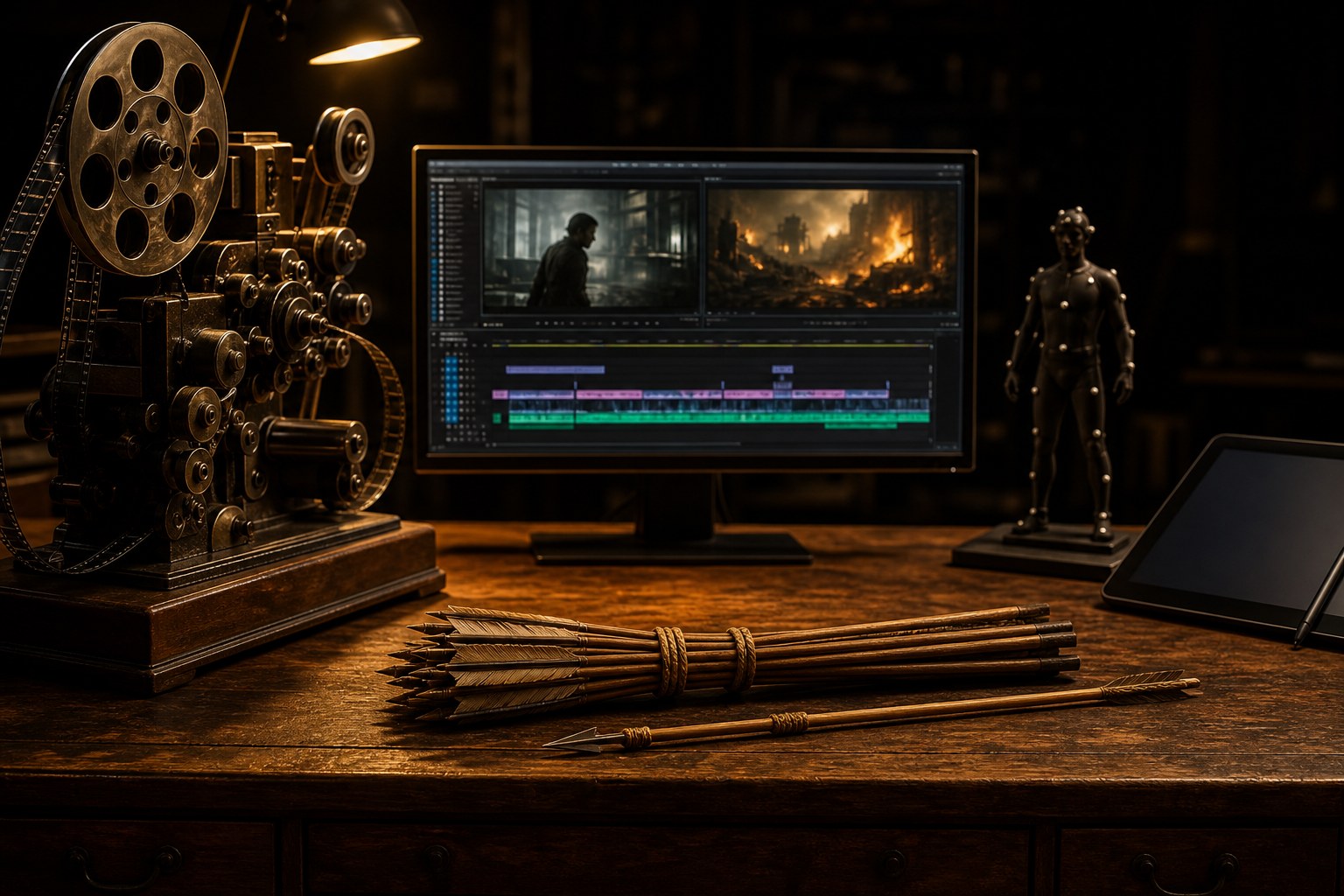
Here is why I settled on many models instead of one. You can snap a single arrow in your hand. You cannot break a bundle of them. Any one provider is a weakness, they get pulled, they get expensive, they get leapfrogged, but many models held together, from different companies, each lending its own character to the mix, make the whole build stronger. Now set that bundle in a quiver, in our case the engineered scaffolding that holds the models in formation and keeps them aimed where you point them, and you are not only strong, you can carry that strength anywhere and wield it with confidence. That is not a philosophy I adopted. It is the thing that literally made it possible to build what became Auteur Intelligence.
What has changed for me, concretely? I used to avoid ComfyUI, because building with nodes confused me. Today I have something like thirty free, open-source tools running locally through Comfy, generation, editing, upscaling, and I never open the interface. Auteur runs it under the hood. The same is true of Fusion inside Resolve. Nodes confuse me. Now I get the result I want out of Fusion, and the nodes are optional. And somewhere in trying to perfect the process of helping my own work, I built an underlying coding tool with all the checks, balances, and security, and it turned out to be perhaps the most important tool in the whole stack. It grew, like everything else here, out of necessity.
The writing was the proof I felt most. I had tried using AI to help with my own writing for years. It was fine for short things, but it forgot. Then one day it did not. It reminded me of what had worked four chapters earlier, something I had forgotten myself. That was the day I knew.
This represents almost a year of coding: trial and error, mistakes, challenges, and the occasional triumph. It is being used right now, every day, on real documentary and narrative productions of mine that run to hundreds of hours of footage. My vision reaches the screen in days instead of weeks.
I have been at this edge before, where a tool changes everything. I started cutting film on an upright Moviola in film school. I directed music videos and colored them in a Hollywood suite on DaVinci Resolve when that suite cost three thousand dollars an hour. I ran a company making publicly funded documentaries when HD first came online and DSLRs suddenly made cheap footage look filmic. I spent a pandemic year moving my studio into motion capture and 3D, brute-forcing my way to understanding until it worked.
We are in the middle of another revolution now, and this one is the biggest yet. It lets anyone become an auteur, in any discipline they choose, if they have the vision, the good ideas, and the gumption to chase them. It reminds me of the earliest days of cinema, Lumière and Edison fiddling with the first moving images, when anything was possible.
And here is the difference between you and the majors. With the tools Auteur Intelligence puts in your hands, you can do in weeks or months what will take them years: a large multiplayer game world, a compelling narrative feature, a serious AI-assisted literary work, or an AI-built business you code, optimize, distribute, and market with tools you own, using intelligence you decide when, how, and where to use, however you see fit.
Anything is possible again. For the people willing to embrace it, imagination is king, and a single vision can stand beside the largest productions in the world. A new generation of auteurs has arrived.